

Business Process Reengineering: addressing the growth challenges businesses face.
Reviewing your company’s processes is essential to keep pace with change and pursue operational efficiency.
These are the challenges entrepreneurs face today and that can be tackled through a Business Process Reengineering project:
Closing the gap between skills and innovation
The real challenge is not just adopting new tools, but making them work together with people.
A BPR project accelerates the transformation of your processes by strategically integrating data and advanced technologies with your employees’ know-how, turning resistance to change into a tangible competitive advantage.
Overcoming outdated business processes
In a fast-moving market, inefficiency is the greatest risk.
BPR makes efficiency an operational standard, ensuring that the company structure is capable of supporting growth objectives.
Managing uncertainty in a fluid market
Today’s economy demands immediate responsiveness.
Through BPR, you turn the need to adapt into a structured capability, enabling your business to reshape its management processes in real time without losing stability or profitability.
Govern the complexity of change
The variables involved in any change process are numerous and layered.
Business Process Reengineering gives you a method for organising internal processes and managing change effectively, turning it into an opportunity to optimise responsibilities and workflows.
Are you facing one of these challenges?
Business Process Reengineering is the right solution for you.
Business Process Reengineering: what is it and how does it work?
Business Process Reengineering refers to the redesign of all or some of a company’s information processes, which may concern the organisation as a whole or a specific part of its structure.
BPR acts on information processes, meaning the methods and ways in which departments and people communicate and exchange information. Through this process, it becomes possible to redesign the flow of information, introduce new procedures to improve operational efficiency, and use control systems to manage data and information securely.
Business Process Reengineering is often carried out with the support of an expert in operational efficiency, such as an Innovation Manager.
The ultimate goal is therefore to make information easier to access and use, ensuring that it is reliable, secure, usable, and easy to retrieve, thus reducing both time and costs related to its management and availability.

Improve operational efficiency
Business Process Reengineering:
why start a project?
To succeed in digital transformation, it is essential to integrate decision-making processes in a way that is intuitive, complete, and efficient, creating an intelligent workflow in which information is collected and managed effectively.
This allows information management software and employee skills to work in synergy, making work more predictive, automated, and transparent.
The benefits of a BPR project
By focusing on updating information management and access processes through a Business Process Reengineering project, it becomes possible to significantly reduce information management costs and simplify the work of different business departments.
Maximum agility in evolving your operating model
The first major benefit is the elimination of bottlenecks. BPR realigns processes with your new organisational reality, turning structural changes into opportunities to ensure business continuity and higher performance.
Full return on investment (ROI) from new software
Introducing an ERP or CRM without reviewing processes is a financial risk. One of the key advantages of BPR is that it optimises workflows before automation, ensuring that technology acts as a value accelerator rather than an unnecessary cost.
Greater efficiency through technology upgrades
Reengineering your processes allows you to unlock the full potential of innovation. The concrete advantage? Eliminating low-value activities so your team can focus only on what generates profit.
Immediate scalability and competitive advantage
In a highly competitive market, efficiency is your strongest defence. BPR drastically reduces operating costs and response times (time-to-market), making your company leaner, more scalable, and significantly more competitive.
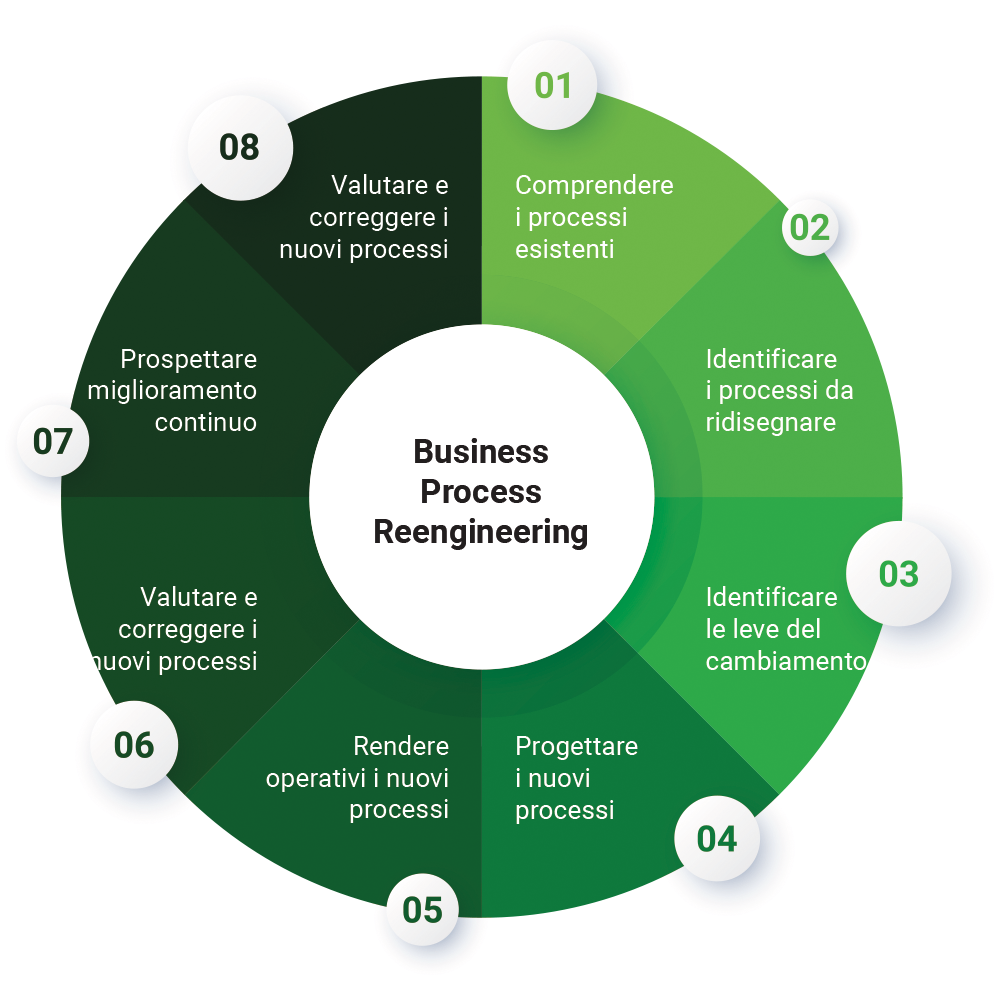
The 8 steps to implement Business Process Reengineering with Polo Innovativo.
1. Understand current processes: AS IS analysis
The initial phase consists of an in-depth analysis of current business processes (AS IS) to gain a clear view of the organisation and the stakeholders involved.
This activity culminates in the creation of the Current State Map, a visual representation that highlights the client’s actual needs (Voice of Customer) and makes it possible to define project goals on a solid basis.
2. Identify the processes to improve
The next step is to identify the processes to be redesigned by collecting detailed data on time, costs, and resources, in order to highlight inefficiencies and non-value-added activities through the Value Stream Map.
The definition of the Future State Map then makes it possible to visualise the benefits generated by reengineering, while the introduction of specific KPIs ensures measurable performance and continuous monitoring of progress against the objectives set.
3. Identify the levers of change
Managing Business Process Reengineering requires addressing the inevitable resistance to change within the organisation. To overcome it, the Innovation Manager and the leaders involved must act as facilitators, using relationship skills, leadership, and empathy to motivate staff.
Clearly communicating the importance of the project and actively involving teams not only reduces resistance, but also accelerates the adoption of new processes, making the benefits of change more immediate and shared.
4. Design the new processes
Once the areas for improvement have been identified, the next step is the operational design of the new processes, starting with brainstorming sessions involving the development team.
The resulting activities are then organised and planned using Project Management methodologies, with tools such as the WBS and the Gantt chart to ensure deadlines and budgets are met.
At this stage, the Project Charter becomes the essential reference document: since it contains objectives, constraints, and resources, it must be constantly updated to reflect the evolution of the project and guide execution correctly.
5. Make the new processes operational
Once the design phase has been completed, the new processes must be shared with managers and the workloads defined in the WBS must be allocated to team members.
To manage this stage effectively and establish responsibilities, the RACI matrix is used, distinguishing between those who carry out the activities operationally (Responsible), those who have final accountability (Accountable), the experts consulted for decisions (Consulted), and those who need to be updated on developments because they are affected by the outcomes (Informed).
6. Evaluate and refine the new processes
Once the new processes have been implemented, it is essential to verify that the results achieved are aligned with the initial objectives through KPI analysis. This monitoring makes it possible to correct any errors and further refine operational efficiency by intervening again where necessary.
At the same time, it is important to assess how well the changes have been integrated into the business context and how different departments have responded, and finally to compare the whole project with what was set out in the Project Charter in order to validate its success or update the reference documentation.
7. Promote continuous improvement
After successfully implementing the new processes, it is necessary to spread the Kaizen culture of continuous improvement throughout the organisation, involving all company members in the change and repeating the eight BPR phases cyclically.
This creates a virtuous cycle capable of further improving efficiency and keeping pace with change through listening to and involving internal staff.
8. Develop concrete objectives
The final phase is a direct consequence of the continuous improvement process and consists of setting new, concrete, and achievable objectives.
Setting ambitious goals is certainly important to generate enthusiasm within the team; however, it is equally important to think pragmatically, planning many small steps to be carried out consistently over time.
This will make it possible to refine the techniques learned, work efficiently, and reduce the likelihood of errors.