SFDR, which stands for Sustainable Finance Disclosure Regulation, is a European Union regulation that came into force in 2021, requiring financial market participants to disclose standardised, transparent information about their investment products.
The purpose of the SFDR is to combat greenwashing, improve transparency and make it easier to compare financial products — ultimately helping capital flow towards a genuinely more sustainable economy.
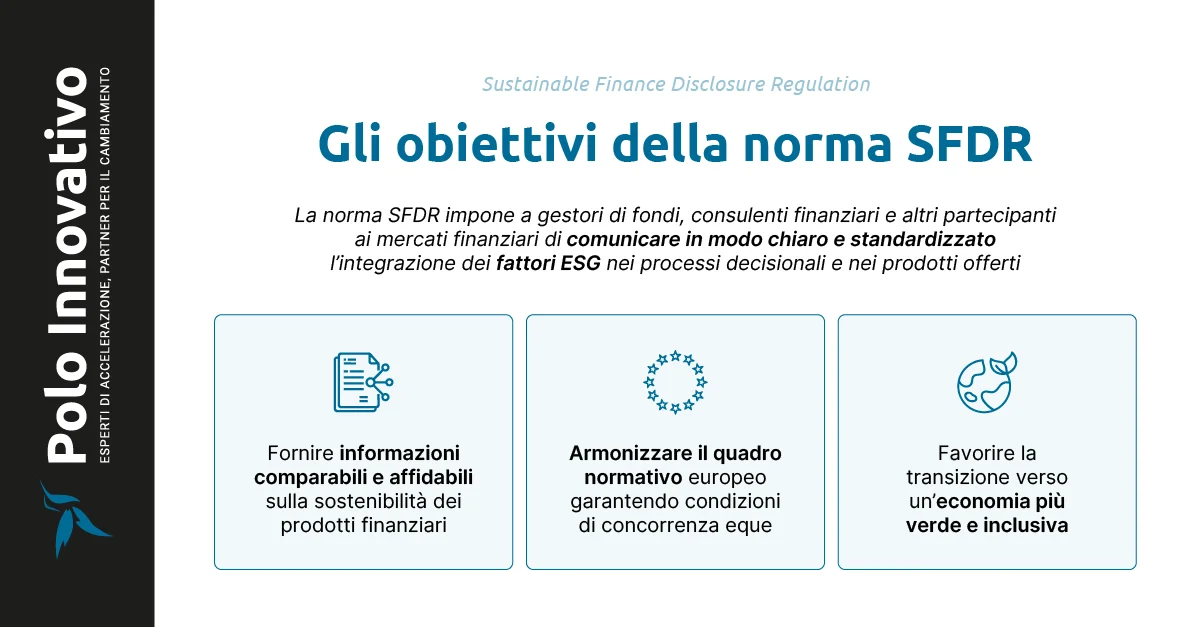
The objectives of the SFDR
The SFDR (Sustainable Finance Disclosure Regulation) was developed within the framework of the European Green Deal and the United Nations 2030 Agenda, with the dual aim of directing capital flows towards sustainable economic activities and reducing the risk of "greenwashing" — the practice of labelling products as sustainable when they are not.
In essence, the SFDR requires fund managers, financial advisers and other financial market participants to communicate clearly and consistently how they incorporate ESG factors into their decision-making processes and the products they offer.
One of the regulation's primary goals is to give investors comparable, reliable information about the sustainability characteristics of financial products, enabling them to make more informed choices and supporting a more responsible financial system overall.
The regulation establishes disclosure obligations at two levels: the entity level (i.e. the financial intermediary) and the product level (i.e. the fund or investment instrument).
Notably, the SFDR introduces a classification system for financial products based on their degree of sustainability: Article 6 covers products that do not specifically integrate ESG factors; Article 8 applies to products that promote environmental or social characteristics; and Article 9 applies to those with a dedicated sustainable investment objective.
Another core objective of the SFDR is to harmonise the European regulatory landscape, reducing the fragmentation of national rules and ensuring a level playing field across the financial sector.
The transparency the regulation demands also helps improve the management of sustainability risks — that is, environmental, social or governance events or conditions that could negatively affect the value of investments.
Taken together, the SFDR is a key instrument in driving the transition towards a greener, more inclusive economy, promoting an integrated and responsible approach to sustainable finance.
SFDR: what counts as a sustainable investment?
The SFDR defines a sustainable investment as:
"an investment in an economic activity that contributes to an environmental objective, as measured, for example, by key resource efficiency indicators concerning the use of energy, renewable energy, raw materials, water and land, the production of waste, and greenhouse gas emissions, as well as its impact on biodiversity and the circular economy; or an investment in an economic activity that contributes to a social objective, in particular one that contributes to tackling inequality, or which fosters social cohesion, social integration and labour relations, or an investment in human capital or economically or socially disadvantaged communities, provided that such investments do not significantly harm any of those objectives and that the investee companies follow good governance practices, in particular with respect to sound management structures, employee relations, remuneration of staff and tax compliance."
We can distil this lengthy definition down to the first two letters of the ESG acronym: a sustainable investment is one in an economic activity that delivers meaningful impact on the Environmental (E) and Social (S) fronts.
Governance comes in as a qualifying condition: no investment qualifies as sustainable if the company being invested in lacks robust management and reporting systems.
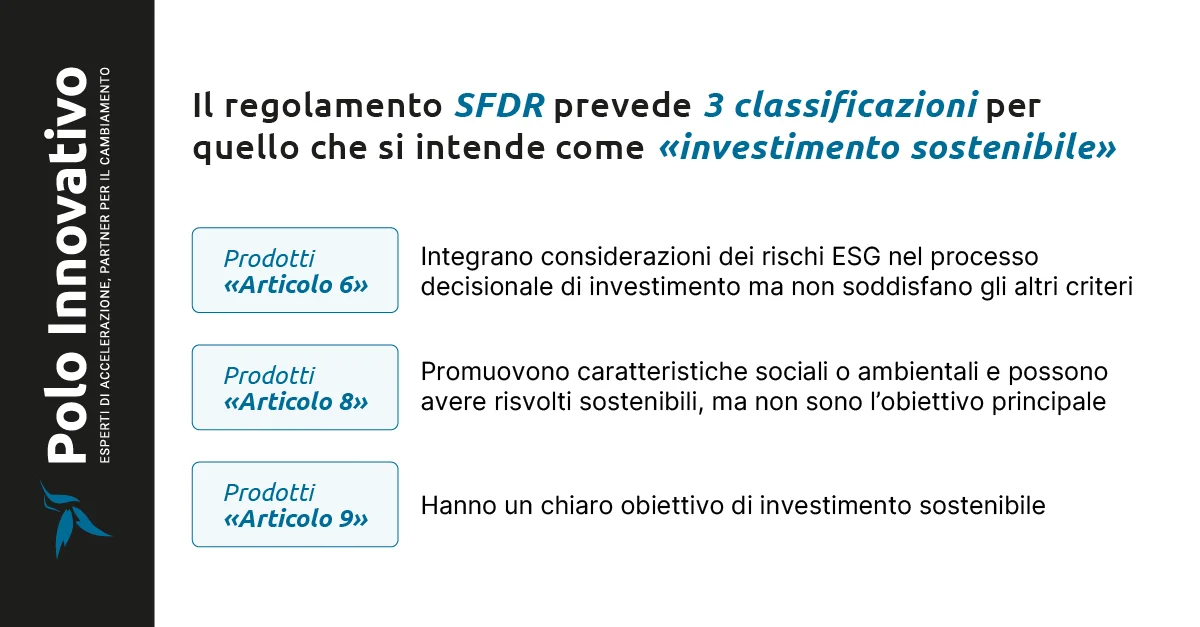
Specifically, the SFDR provides three classifications for what it considers a "sustainable investment":
- "Article 6" products: these products integrate ESG risk considerations into the investment decision-making process (or can explain why such risks are not relevant), but do not meet the additional criteria;
- "Article 8" products: these products promote social or environmental characteristics and may have sustainability features, but sustainability is not their primary investment objective;
- "Article 9" products: these products have a clearly defined sustainable investment objective.
Who does the SFDR apply to?
The SFDR applies to all financial market participants and financial advisers based in the European Union, as well as to investment managers and advisers based outside the EU who market their products to EU clients.
The products covered by the regulation include UCITS, AIFs, separately managed portfolios and sub-advisory mandates, as well as financial advice when provided within the EU or by an EU investment firm.
The United Kingdom falls outside the scope of the SFDR; however, in 2021 the Financial Conduct Authority published a framework broadly comparable to it.
What is the EU Taxonomy Regulation and how does it relate to the SFDR?
The EU Taxonomy Regulation (EU Regulation 2020/852) is a complementary instrument to the SFDR, designed to create a common, consistent language for defining what counts as a sustainable economic activity within the European Union.
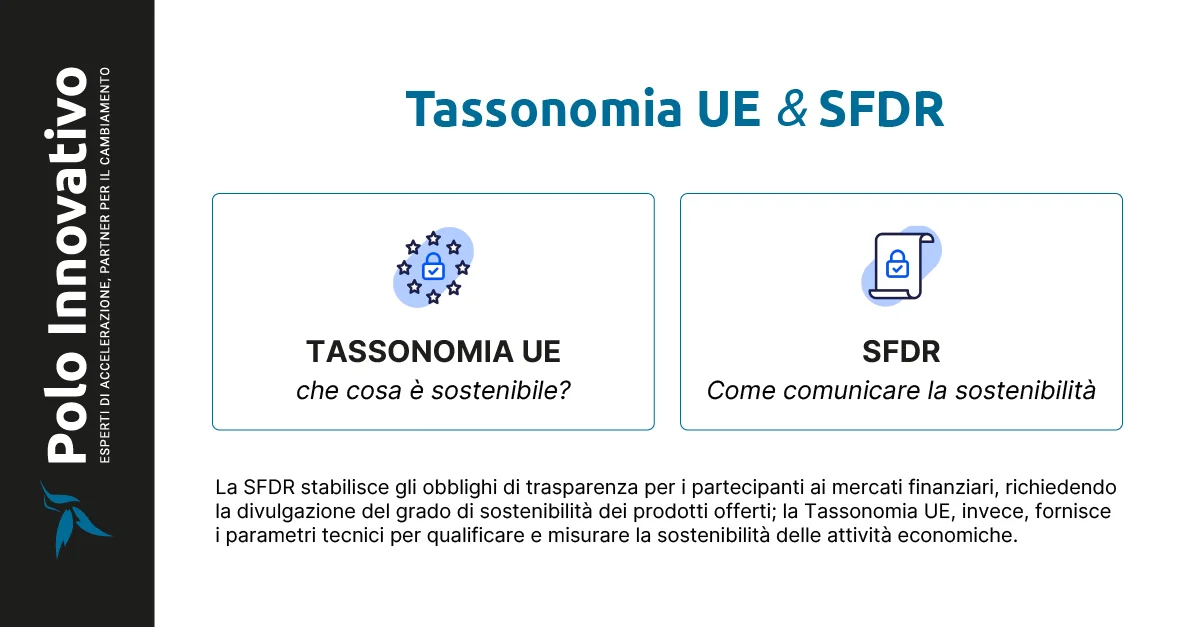
While the SFDR requires financial market participants to disclose transparent, comparable information on the ESG risks and impacts of their products, the EU Taxonomy sets the technical criteria for determining whether an economic activity can genuinely be considered environmentally sustainable.
Put simply, the SFDR governs "how to communicate" sustainability, while the Taxonomy defines "what is sustainable".
The main objectives of the EU Taxonomy
The Taxonomy Regulation was introduced to:
For an economic activity to be considered "environmentally sustainable" under the Taxonomy, it must make a substantial contribution to at least one of the following six environmental objectives:
In addition, the activity must Do No Significant Harm (DNSH) to any of the other environmental objectives, and must meet minimum social and governance safeguards.
How the SFDR and the Taxonomy work together
The two frameworks operate in synergy:
- The SFDR sets the transparency obligations for financial market participants, requiring disclosure of the degree of sustainability of the products they offer;
- The EU Taxonomy provides the technical parameters for qualifying and measuring the sustainability of the underlying economic activities.
In practice, financial products classified as Article 8 or Article 9 under the SFDR must disclose the extent to which the investments held in the portfolio are aligned with the Taxonomy.
This allows investors to better understand the actual level of contribution their funds make to the EU's environmental objectives, and to distinguish genuinely sustainable products from those that merely promote ESG characteristics.
Conclusion
The SFDR stands as one of the cornerstones of Europe's journey towards a more sustainable, transparent and accountable financial system. Together with the EU Taxonomy Regulation, it forms an integrated regulatory framework aimed at steering private capital towards genuinely sustainable economic activities, in line with the objectives of the European Green Deal and the United Nations 2030 Agenda.
Thanks to these instruments, investors now have access to clearer, more comparable and verifiable information on the sustainability of financial products, empowering them to make more informed investment decisions. At the same time, companies and financial market participants are expected to adopt a more rigorous, transparent and strategic approach to managing ESG (Environmental, Social, Governance) factors.
The transition to a low-emission, socially equitable economy requires a financial system that rewards responsible businesses and discourages greenwashing.
In this sense, the SFDR is more than a technical regulation — it represents a paradigm shift: it fosters a financial culture where sustainability becomes a structural element of investment decisions, not merely a value-added extra.
Ultimately, the SFDR marks a decisive step towards a future in which finance and sustainability advance together, creating value that goes beyond the purely economic — generating environmental and social benefits for businesses, investors and society as a whole.
FAQ
Cos'è la SFDR?
La Sustainable Finance Disclosure Regulation (Regolamento UE 2019/2088), entrato in vigore nel 2021, è un regolamento europeo che impone agli operatori finanziari di fornire informazioni standardizzate e trasparenti sui prodotti d'investimento. L'obiettivo è evitare il greenwashing, migliorare la trasparenza e facilitare il confronto tra prodotti finanziari, orientando gli investimenti verso un'economia realmente sostenibile.
Cosa significano le classificazioni Articolo 6, 8 e 9 della SFDR?
Sono i tre livelli di sostenibilità dei prodotti finanziari:
Articolo 6: prodotti che integrano i rischi ESG nel processo decisionale ma senza promuovere specifiche caratteristiche sostenibili;
Articolo 8: prodotti che promuovono caratteristiche ambientali o sociali, ma senza farne l'obiettivo principale;
Articolo 9: prodotti con un chiaro obiettivo di investimento sostenibile.
A chi si applica il regolamento SFDR?
A tutti gli operatori finanziari e consulenti finanziari con sede nell'UE, oltre che ai gestori e consulenti extra-UE che commercializzano i propri prodotti a clienti UE. I prodotti interessati includono UCITS, FIA, portafogli a gestione separata e mandati di sub-consulenza.
Qual è la relazione tra SFDR e Tassonomia UE?
Sono complementari: la SFDR stabilisce "come comunicare" la sostenibilità, mentre la Tassonomia UE (Regolamento 2020/852) definisce "che cosa è sostenibile", fissando i criteri tecnici per valutare se un'attività economica è ecosostenibile. I prodotti Articolo 8 e 9 devono dichiarare in che misura gli investimenti siano allineati alla Tassonomia.
Quali sono i 6 obiettivi ambientali della Tassonomia UE?
Mitigazione dei cambiamenti climatici, adattamento ai cambiamenti climatici, uso sostenibile delle risorse idriche e marine, transizione verso un'economia circolare, prevenzione e controllo dell'inquinamento, protezione e ripristino della biodiversità e degli ecosistemi. Ogni attività deve contribuire sostanzialmente ad almeno un obiettivo senza danneggiare gli altri (DNSH).